


The New Frontier in Regenerative Wellness
In the world of regenerative medicine, longevity science, and advanced wellness, few molecules have generated as much interest as GHK-Cu, a naturally occurring copper-binding peptide often referred to as the “regenerative copper peptide.”
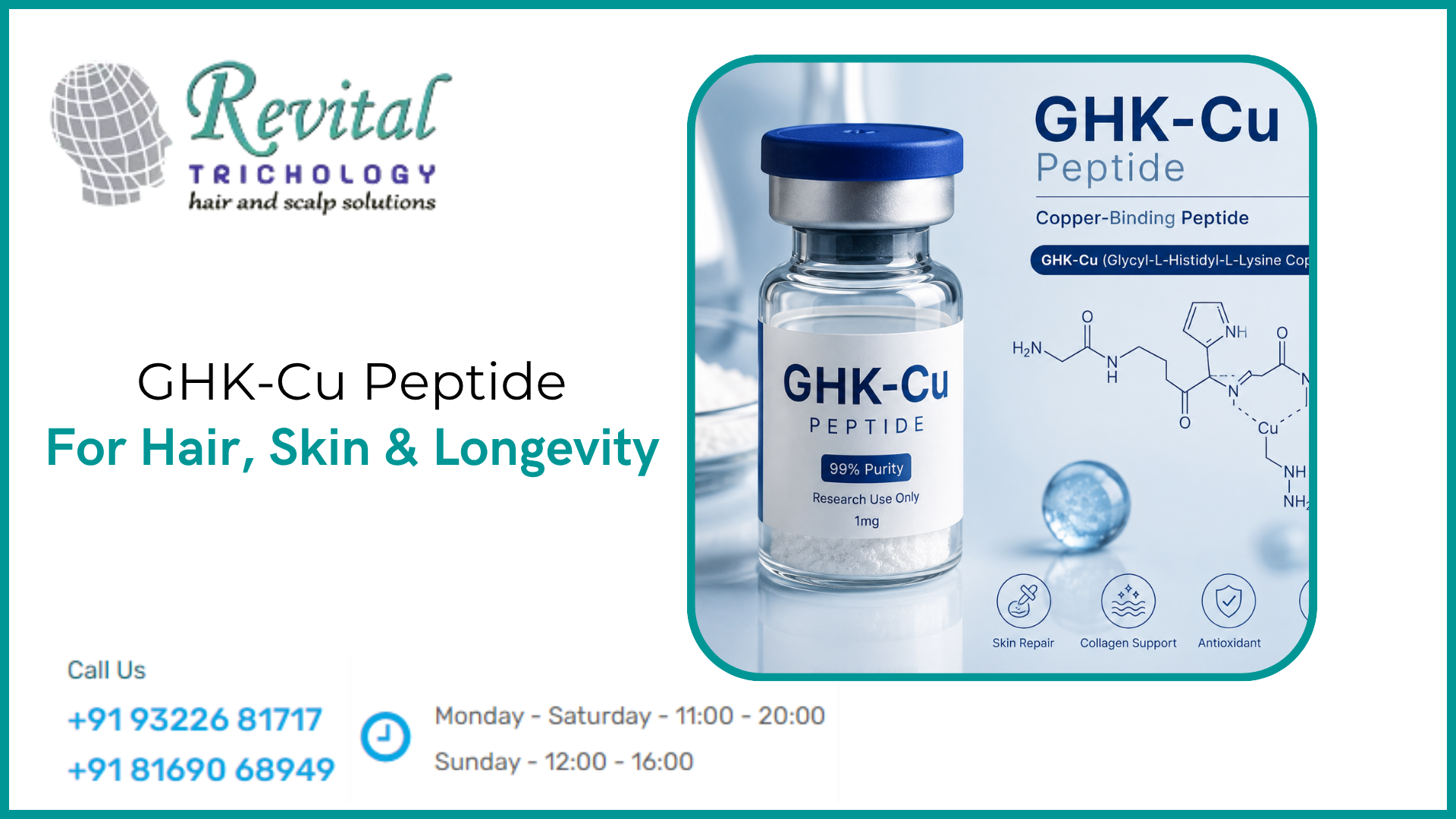
Originally discovered in human plasma in the 1970s, GHK-Cu (Glycyl-L-Histidyl-L-Lysine Copper) is now being explored for its potential role in:
- Skin rejuvenation
- Hair restoration
- Collagen production
- Tendon and ligament support
- Connective tissue repair
- Anti-inflammatory signaling
- Muscle recovery and tissue healing
- Healthy aging and longevity
As we age, natural levels of GHK decline significantly. Researchers believe this reduction may partly contribute to slower healing, collagen loss, inflammation, tissue degeneration, and visible signs of aging.
Today, GHK-Cu is widely discussed in anti-aging medicine, aesthetic medicine, trichology, regenerative orthopedics, and wellness optimization.
At Revital Trichology & Wellness, we believe peptides represent one of the most exciting emerging frontiers in longevity-focused healthcare — when used responsibly, ethically, and under medical supervision.
What Exactly Is GHK-Cu?
GHK-Cu is a naturally occurring tripeptide composed of three amino acids:
- Glycine
- Histidine
- Lysine
When bound with copper ions, it forms the biologically active compound GHK-Cu.
Copper is an essential trace mineral involved in:
- Collagen synthesis
- Elastin formation
- Antioxidant defense
- Tissue remodeling
- Blood vessel formation
- Cellular repair mechanisms
GHK-Cu acts as a carrier and signaling peptide that helps regulate tissue repair and cellular communication.
Researchers have identified its influence on thousands of genes associated with:
- Regeneration
- Inflammation
- Oxidative stress
- Tissue remodeling
- Wound healing
- Cellular survival
This is one reason GHK-Cu has become such an important molecule in anti-aging and regenerative research.
Why Is GHK-Cu Called an Anti-Aging Peptide?
Aging is not simply about wrinkles or hair thinning.
Biological aging involves:
- Collagen degradation
- Chronic low-grade inflammation (“inflammaging”)
- Reduced cellular repair
- Muscle decline
- Connective tissue degeneration
- Mitochondrial dysfunction
- Slower wound healing
- Oxidative stress accumulation
GHK-Cu has attracted attention because studies suggest it may influence several of these pathways simultaneously.
Rather than acting as a stimulant alone, GHK-Cu appears to function as a tissue-remodeling and repair signaling peptide.
This is why it is increasingly being explored in:
- Longevity medicine
- Functional medicine
- Regenerative aesthetics
- Hair restoration medicine
- Sports recovery
- Healthy aging protocols
GHK-Cu and Collagen Production
One of the most extensively studied benefits of GHK-Cu is its effect on collagen synthesis.
Collagen is the primary structural protein responsible for:
- Skin firmness
- Elasticity
- Tendon strength
- Ligament integrity
- Joint support
- Healthy fascia
- Blood vessel structure
As collagen declines with age, the body becomes more vulnerable to:
- Wrinkles
- Skin laxity
- Tendon injuries
- Poor wound healing
- Ligament weakness
- Reduced tissue resilience
Research suggests GHK-Cu may stimulate fibroblasts — the cells responsible for producing collagen, elastin, and components of the extracellular matrix.
Potential benefits being explored include:
- Improved skin texture
- Better elasticity
- Enhanced tissue repair
- Reduced appearance of fine lines
- Support for post-procedure recovery
- Healthier connective tissue remodeling
Unlike aggressive approaches that attempt to force collagen production, GHK-Cu appears to support more balanced tissue remodeling.
GHK-Cu for Hair Health and Hair Regeneration
GHK-Cu has become increasingly popular in advanced hair restoration medicine.
Hair loss is often associated with:
- Inflammation around follicles
- Oxidative stress
- Reduced blood supply
- Fibrosis around follicles
- Aging-related decline in growth signaling
- Hormonal influences
Research suggests GHK-Cu may support scalp and follicular health through multiple mechanisms.
Potential Hair & Scalp Benefits
1. Improved Scalp Environment
GHK-Cu may help reduce inflammatory signaling and oxidative stress around hair follicles.
2. Support for Blood Vessel Formation
Healthy follicles require oxygen and nutrient delivery. GHK-Cu has been studied for its role in angiogenesis and vascular support.
3. Collagen Remodeling Around Follicles
Excess fibrosis around follicles may negatively affect hair growth. GHK-Cu may support healthier extracellular matrix balance.
4. Improved Scalp Healing
The peptide is increasingly explored in post-procedure recovery after:
- Microneedling
- PRP
- Exosome therapies
- Hair transplantation
5. Cosmetic Hair Quality
Some users report:
- Improved hair texture
- Reduced breakage
- Better scalp quality
- Healthier-looking hair
However, it is important to understand that research is still evolving, and responses may vary.
GHK-Cu and Connective Tissue Health
One of the most exciting areas of emerging research is the role of GHK-Cu in connective tissue repair.
Connective tissues include:
- Tendons
- Ligaments
- Fascia
- Cartilage support structures
- Skin matrix
- Joint-supporting tissues
These tissues heal slowly because they often have limited blood supply.
Researchers are now exploring whether GHK-Cu may support:
- Tendon recovery
- Ligament healing
- Tissue remodeling
- Reduced inflammatory stress
- Improved collagen organization
- Recovery from overuse injuries
Athletes, active individuals, and aging adults are increasingly interested in peptides that may support structural integrity and recovery.
Although human clinical evidence is still limited, regenerative medicine clinics continue to investigate the potential role of GHK-Cu in connective tissue support.
GHK-Cu and Muscle Recovery
Muscle health is closely tied to healthy aging.
After age 35–40, many individuals begin experiencing:
- Reduced muscle recovery
- Loss of lean muscle mass
- Increased soreness
- Slower healing
- Reduced exercise resilience
Chronic inflammation and oxidative stress contribute significantly to muscle decline.
GHK-Cu is being studied for its possible role in:
- Recovery signaling
- Tissue repair pathways
- Antioxidant defense
- Cellular resilience
- Inflammatory modulation
Some regenerative medicine practitioners are exploring its use as part of broader healthy aging and recovery protocols.
However, more human clinical trials are still needed.
Anti-Inflammatory and Antioxidant Potential
Chronic low-grade inflammation is now considered one of the biggest drivers of aging and degenerative disease.
This phenomenon is commonly referred to as “inflammaging.”
Excess inflammation may contribute to:
- Hair loss
- Skin aging
- Joint degeneration
- Muscle breakdown
- Fatigue
- Metabolic dysfunction
- Cardiovascular stress
Research suggests GHK-Cu may influence inflammatory pathways and oxidative stress signaling.
Potential mechanisms being explored include:
- Reduction in pro-inflammatory cytokines
- Antioxidant enzyme support
- Reduction in oxidative tissue damage
- Improved tissue healing environment
This is one reason GHK-Cu has become so popular in regenerative and longevity medicine.
GHK-Cu and Non-Healing Wound Support
One of the earliest areas of scientific interest surrounding GHK-Cu involved wound healing and tissue regeneration.
Researchers have explored its potential role in supporting:
- Tissue remodeling
- Collagen formation
- Skin repair signaling
- Reduction in inflammatory stress
- Blood vessel support
- Cellular recovery mechanisms
Because of these regenerative properties, topical GHK-Cu formulations are increasingly being explored in integrative and regenerative medicine settings for skin recovery and difficult-to-heal tissue environments.
Could Topical GHK-Cu Help Non-Healing Wounds?
Emerging research suggests topical copper peptide formulations may support the healing environment in certain slow-healing or chronically inflamed wounds by helping promote:
- Collagen synthesis
- Tissue granulation
- Improved skin repair signaling
- Reduced oxidative stress
- Better tissue remodeling
- Supportive wound-healing microenvironment
Some regenerative practitioners are exploring topical GHK-Cu in carefully selected cases involving:
- Delayed skin healing
- Cosmetic procedure recovery
- Aging-related slow healing
- Fragile skin
- Superficial tissue recovery support
However, it is extremely important to understand:
GHK-Cu is not a replacement for proper wound care.
Non-healing wounds may sometimes indicate:
- Diabetes or insulin resistance
- Poor circulation
- Infection
- Nutritional deficiencies
- Autoimmune conditions
- Vascular disease
- Pressure injuries
- Other serious medical concerns
These conditions require comprehensive medical evaluation.
Topical GHK-Cu should only be considered as part of a supervised wound-care strategy under qualified healthcare guidance.
Self-treatment of chronic wounds without medical supervision is strongly discouraged.
GHK-Cu and Skin Rejuvenation
Copper peptides are widely used in advanced skincare because of their regenerative potential.
Potential skin benefits may include:
- Improved elasticity
- Enhanced hydration
- Better skin texture
- Reduction in visible signs of aging
- Improved barrier recovery
- Support for post-procedure healing
- Reduction in photodamage appearance
GHK-Cu is increasingly used in:
- Serums
- Regenerative facials
- Microneedling protocols
- Exosome-based therapies
- Post-laser recovery
- Anti-aging formulations
Because it works through tissue signaling rather than harsh exfoliation, many users find copper peptides gentler than more aggressive anti-aging compounds.
Is GHK-Cu a Research Peptide?
Yes.
It is extremely important to understand that many forms of injectable or compounded GHK-Cu are considered research or investigational compounds.
While topical cosmetic formulations containing copper peptides are widely available, injectable and advanced therapeutic applications are still evolving.
Human clinical evidence is promising but remains limited in several areas.
Current evidence includes:
- Laboratory studies
- Animal research
- Cell signaling research
- Small human studies
- Cosmetic and regenerative medicine observations
More large-scale human clinical trials are still needed.
GHK-Cu should not be viewed as a miracle cure or replacement for evidence-based medical care.
Safety Considerations and Supervision
GHK-Cu should always be used under qualified medical supervision.
Why?
Because peptides influence biological signaling pathways, improper use may create unintended effects.
Important considerations include:
- Product purity
- Accurate dosing
- Route of administration
- Sterility
- Individual health conditions
- Copper balance
- Interaction with medications or therapies
Potential Side Effects
Although many users tolerate copper peptides well, potential side effects may include:
- Skin irritation
- Injection site reactions
- Sensitivity reactions
- Redness or itching
- Headache
- Temporary inflammation
- Product contamination risks from poor-quality sourcing
Because GHK-Cu influences tissue remodeling pathways, unsupervised experimentation is strongly discouraged.
This is especially important with injectable peptides purchased from unreliable online sources.
Who May Explore GHK-Cu Under Supervision?
Depending on individual assessment and physician guidance, GHK-Cu may be explored by people interested in:
- Healthy aging support
- Hair and scalp wellness
- Skin rejuvenation
- Connective tissue support
- Sports recovery
- Regenerative wellness protocols
- Post-procedure healing support
- Longevity-focused wellness
However, it is not appropriate for everyone.
Individual medical history, medications, metabolic health, inflammation status, and goals should always be evaluated first.
GHK-Cu in Integrative and Longevity Medicine
Modern longevity medicine is moving away from simply masking symptoms.
The focus is increasingly shifting toward:
- Cellular resilience
- Tissue regeneration
- Recovery optimization
- Inflammation reduction
- Healthy aging pathways
- Structural integrity
- Functional wellness
Peptides like GHK-Cu are part of this broader regenerative conversation.
Rather than acting like a conventional pharmaceutical drug, GHK-Cu appears to function more like a biological signaling molecule.
This makes it especially interesting in:
- Anti-aging medicine
- Sports medicine
- Aesthetic medicine
- Hair restoration
- Functional medicine
- Regenerative medicine
The Future of GHK-Cu Research
Researchers continue exploring the potential of GHK-Cu in areas such as:
- Fibrosis modulation
- Tissue regeneration
- Hair follicle biology
- Wound healing
- Healthy aging
- Neuroprotection
- Skin regeneration
- Connective tissue recovery
- Oxidative stress reduction
As regenerative medicine evolves, peptides like GHK-Cu may become increasingly important tools in personalized wellness strategies.
However, scientific rigor and responsible medical use remain essential.
Final Thoughts
GHK-Cu is one of the most fascinating regenerative peptides currently being explored in anti-aging and wellness medicine.
Its potential effects on:
- Collagen synthesis
- Hair health
- Tissue remodeling
- Connective tissue support
- Inflammation modulation
- Skin rejuvenation
- Recovery and regeneration
have made it a major focus of research in longevity and regenerative medicine.
But it is important to remember:
- GHK-Cu is not magic.
- It is not a shortcut to health.
- And it should never be used casually without proper guidance.
At Revital Trichology & Wellness, we believe the future of medicine lies in combining:
- Science-backed regenerative approaches
- Lifestyle optimization
- Nutritional support
- Movement and exercise
- Sleep and recovery
- Hormonal balance
- Advanced longevity strategies
Peptides like GHK-Cu represent an exciting emerging area but responsible use, patient education, and medical supervision remain critical.