


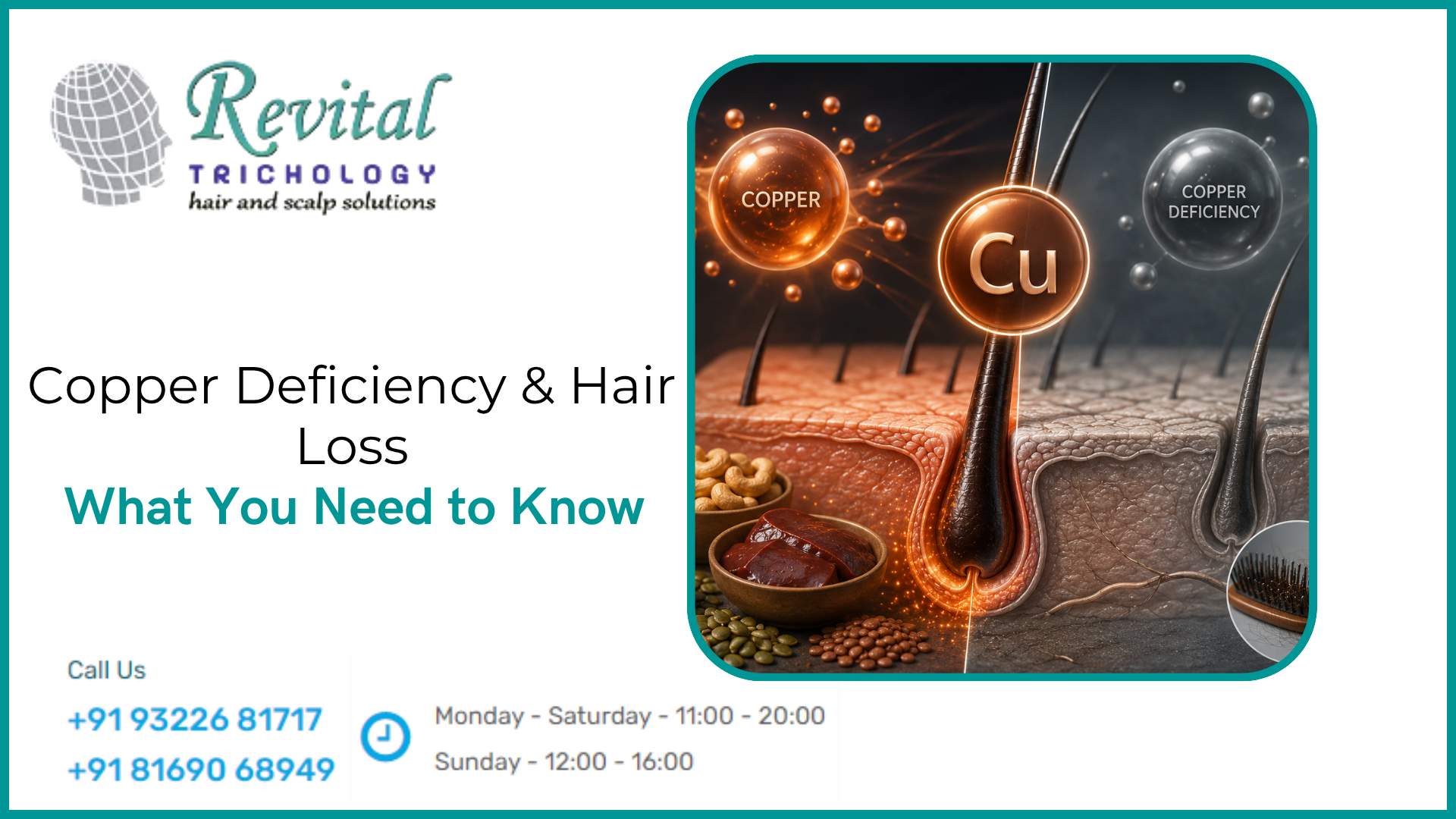
Most people who seek help for hair loss have already investigated the usual causes.
They’ve checked their thyroid function. They’ve tested their iron levels. They’ve started taking biotin supplements. Some have even changed their diet, invested in expensive hair products, and tried treatments recommended online.
Yet the shedding continues.
This is where hair loss can become frustrating. Not because there are no answers, but because some contributing factors receive far less attention than they deserve. Copper is one of them.
It isn’t the first nutrient most people associate with healthy hair. In fact, many people have never considered copper at all. However, this trace mineral plays a surprisingly important role in several biological processes that influence hair growth, hair strength, and even hair colour. Growing interest in regenerative medicine has also led to discussions around GHK-Cu peptide for hair regrowth, a copper-based peptide that is being explored for its potential role in supporting follicular health.
Before looking at copper peptides, it is worth understanding why copper matters in the first place.
When hair loss isn’t as straightforward as it seems
Hair follicles are remarkably demanding structures.
Although a strand of hair appears simple, the follicle beneath the scalp is constantly dividing cells, producing proteins, generating pigment, and maintaining its own growth cycle. To do all of that, it depends on a steady supply of nutrients, oxygen, and cellular support.
When one of those requirements is missing, the follicle often responds by becoming less efficient.
Sometimes the changes are subtle.
Hair may lose some of its thickness. Growth may become slower. Shedding may gradually increase.
The challenge is that these symptoms are rarely unique to copper deficiency. They can resemble dozens of other hair-related conditions.
That is one reason copper-related issues are frequently overlooked.
The nutrient that often gets overshadowed by iron
In hair loss discussions, iron receives most of the attention.
For good reason.
Iron deficiency is one of the most common nutritional causes of excessive hair shedding.
What many people don’t realise is that copper and iron are closely connected.
The body relies on copper to help transport and utilise iron effectively. When copper levels become inadequate, iron metabolism can be affected as well.
This creates an interesting situation.
A person may focus entirely on improving iron levels while an underlying copper imbalance remains unaddressed.
That does not mean copper deficiency is common in every hair loss case.
It isn’t.
But it highlights why nutritional assessment sometimes needs to look beyond the most obvious markers.
Hair follicles need more than nutrients. They need infrastructure.
One mistake people often make is thinking hair growth is simply about feeding the follicle.
The reality is more complicated.
Hair follicles depend on an entire support system.
They require:
- Healthy blood circulation
- Efficient oxygen delivery
- Connective tissue support
- Cellular repair mechanisms
- Balanced inflammatory responses
Copper contributes to several of these functions.
For example, it helps support enzymes involved in collagen and elastin production. These structural proteins are usually discussed in relation to skin, but they are also important for maintaining the environment surrounding the follicle.
A healthy follicle is not just a healthy hair-producing cell.
It is part of a healthy scalp ecosystem.
Why premature greying sometimes enters the conversation
Hair loss is not the only concern linked to copper.
Some people begin investigating copper status after noticing early greying.
This connection exists because copper participates in processes involved in melanin production. Melanin is the pigment responsible for natural hair colour.
Of course, premature greying is influenced by many factors.
Genetics remains one of the biggest.
Age, oxidative stress, medical conditions, and lifestyle factors can all play a role.
Still, copper is part of the biological pathway that helps produce pigment. This is why it occasionally appears in conversations about both hair thinning and colour changes.
Why deficiencies can be difficult to identify
One of the reasons copper deficiency often flies under the radar is that it rarely announces itself clearly.
The symptoms tend to overlap with other health concerns.
Someone may experience:
- Increased hair shedding
- Low energy levels
- Reduced exercise tolerance
- Poor recovery
- Frequent illness
- Changes in hair texture
None of these symptoms automatically point towards copper.
In fact, many people attribute them to stress, ageing, poor sleep, or a busy lifestyle.
Sometimes those explanations are correct.
Sometimes they are not.
This is why proper investigation matters more than assumptions.
The problem with treating hair loss one nutrient at a time
People naturally want simple answers.
If a nutrient affects hair growth, it seems logical to supplement it.
Unfortunately, biology does not always cooperate with that approach.
Minerals interact with one another.
Hormones influence nutrient utilisation.
Digestive health affects absorption.
Inflammation can alter how nutrients are used throughout the body.
As a result, hair loss rarely comes down to a single deficiency in isolation.
A patient may have:
- Mild iron deficiency
- Chronic stress
- Hormonal fluctuations
- Low protein intake
all at the same time.
In those situations, correcting one factor while ignoring the others may only produce limited results.
Why copper peptides are attracting attention
While nutritional copper has been studied for many years, copper peptides represent a different area of interest.
The best-known example is GHK-Cu.
Interest in GHK-Cu peptide for hair regrowth has grown because researchers are examining how these peptides may influence cellular activity beyond simple nutrient replacement.
This is where the discussion moves away from deficiency and into regenerative medicine.
Copper peptides are being investigated for their potential involvement in processes related to:
- Tissue repair
- Cellular communication
- Growth factor activity
- Inflammatory regulation
- Scalp health
That distinction is important.
The goal is not necessarily to increase copper levels in the body.
The interest lies in how the peptide may interact with the biological environment surrounding hair follicles.
Why regenerative medicine is changing hair restoration conversations
For years, most hair loss discussions focused on two questions:
Is it genetic?
Or is it hormonal?
Those questions remain important.
However, regenerative medicine has broadened the conversation.
Researchers are increasingly interested in the follicular environment itself.
Why do some follicles remain active longer than others?
Why do some recover after shedding episodes while others struggle?
Why do some patients respond exceptionally well to treatment while others see modest changes?
There are no simple answers.
But therapies involving growth factors, peptides, and regenerative signalling pathways are being explored because they may influence how follicles behave over time.
This is one reason GHK-Cu peptide for hair regrowth continues to attract interest among practitioners working in advanced hair restoration.
What patients often get wrong about hair growth
One common misconception is that healthy hair can be restored by finding a single missing piece.
A single vitamin.
A single supplement.
A single treatment.
Hair biology is rarely that straightforward.
Hair reflects what is happening throughout the body.
Nutritional status matters.
Hormones matter.
Stress matters.
Sleep matters.
Scalp health matters.
Genetics matters.
The most successful treatment plans usually recognise that several factors are operating simultaneously.
This is why comprehensive evaluation often produces better outcomes than chasing individual trends.
Looking beyond the symptom
Hair loss naturally draws attention because it is visible.
People see more hair on their pillow, in the shower, or on their hairbrush.
What they cannot see are the biological processes occurring beneath the surface.
Sometimes copper plays a role.
Sometimes it doesn’t.
The key is understanding the difference.
Identifying the underlying cause of hair loss remains far more valuable than assuming every case requires the same solution.
Conclusion
Copper may not receive the same attention as iron, vitamin D, or biotin, but its role in hair health should not be underestimated. From supporting iron metabolism and connective tissue integrity to participating in pigment production, copper contributes to several processes that help maintain healthy follicular function. At the same time, growing interest in GHK-Cu peptide for hair regrowth reflects a wider movement towards regenerative approaches that focus on supporting the biological environment in which hair follicles operate.
At Revital Trichology & Wellness, we believe successful hair restoration starts with understanding why hair loss is happening in the first place. Rather than focusing on a single nutrient or treatment trend, our team evaluates the full picture, including scalp health, nutritional factors, hormonal influences, lifestyle patterns, and follicular activity, to develop personalised treatment plans designed around the individual rather than the symptom.
Frequently Asked Questions
If my iron levels are normal, could a nutritional issue still be contributing to hair loss?
Yes. Hair growth depends on multiple nutrients working together. Even when iron levels appear normal, deficiencies involving other nutrients, including copper, protein, zinc, or vitamin D, may influence follicular health and contribute to ongoing shedding.
Does copper deficiency always cause noticeable hair loss?
Not necessarily. Some people experience gradual thinning, while others may notice changes in hair texture, slower growth, or premature greying before significant shedding becomes obvious. Symptoms vary depending on the individual and the severity of the deficiency.
Why isn’t copper discussed as often as iron in hair loss treatment?
Iron deficiency is far more common and has been extensively studied in relation to hair loss. Copper deficiency is less frequently identified, which is one reason it tends to receive less attention despite its importance in several biological processes related to hair growth.
What exactly is GHK-Cu peptide for hair regrowth?
GHK-Cu is a naturally occurring copper peptide that is being explored within regenerative medicine because of its potential involvement in tissue repair, cellular signalling, and follicular support. Research in this area continues to evolve.
Can taking a copper supplement improve hair growth?
It may help if a confirmed deficiency exists. However, supplementing without understanding the underlying cause of hair loss can be ineffective and, in some cases, inappropriate. Proper evaluation is always recommended before starting supplementation.
Are copper peptides the same as nutritional copper?
No. Nutritional copper is a trace mineral required by the body for normal function. Copper peptides such as GHK-Cu are compounds that combine copper with a peptide and are being investigated for different biological effects related to tissue support and regeneration.
When should someone investigate nutritional deficiencies as part of a hair loss assessment?
If hair shedding is persistent, unexplained, or continues despite addressing common causes such as stress and scalp care, a comprehensive assessment that includes nutritional evaluation may help identify factors that would otherwise remain unnoticed.