


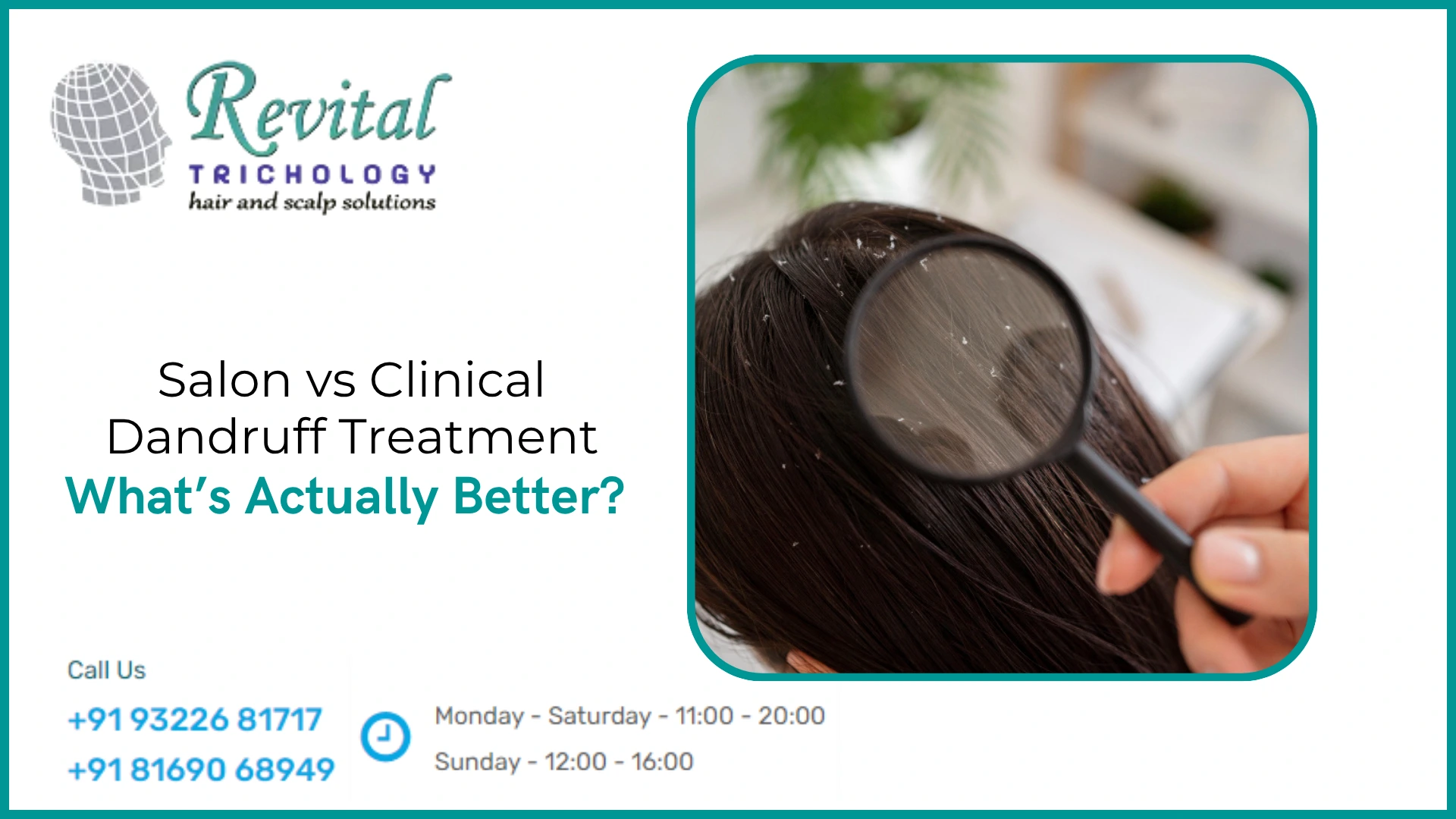
Salon vs Clinical Dandruff Treatment: What’s Better for You?
If you are looking for a reliable dandruff treatment, chances are you have already tried something. A salon cleanup, maybe a medicated shampoo, or both. For a few days, things seem better. The flakes reduce, the itching settles, the scalp feels lighter.
And then, slowly, it comes back.
This is usually where the confusion begins. If both salon and clinical options claim to treat dandruff, why do the results feel so different? The answer sits in how each approach understands the problem itself. Not just how it treats it.
What Dandruff Actually Is, Not Just What It Looks Like
Dandruff is often mistaken for dryness. That assumption sounds reasonable, but it is incomplete.
In most cases, dandruff is linked to a combination of factors:
- Excess oil production on the scalp
- A yeast-like microorganism that feeds on this oil
- A mild inflammatory response triggered by that interaction
- Faster shedding of scalp cells, which appear as flakes
So what you see, the flakes, is only the surface expression. The real issue is an imbalance within the scalp environment.
That distinction matters. Because if the cause is not understood correctly, the treatment tends to stay surface-level.
What Salon Dandruff Treatments Are Designed to Do
Salon treatments are built around immediate improvement. They are structured to clean, soothe, and reset the scalp temporarily.
Typically, this includes:
- Deep cleansing
Removing visible flakes, excess oil, and product buildup. - Exfoliation
Clearing accumulated dead skin to improve scalp texture. - Conditioning or hydration masks
Softening the scalp and reducing visible dryness. - Massage techniques
Increasing circulation and providing a sense of relaxation.
After a session, the scalp does feel better. Cleaner. Less irritated. Visibly improved.
But if you notice closely, the improvement is mostly what you can see and feel right away. It does not always extend beyond that.
Where Salon Treatments Quietly Fall Short
This is not about dismissing salon care. It has its place. But there are limitations that are not always explained clearly.
- Relief tends to be temporary
Flakes reduce, but often return within days or weeks. - The underlying cause is not identified
Whether the dandruff is fungal, inflammatory, or linked to another condition is usually not assessed. - Treatments follow a general pattern
They are not always adjusted based on individual scalp behavior. - The cycle repeats
Clean scalp, temporary relief, recurrence.
For someone with mild or occasional flaking, this may be enough. But for persistent dandruff, it often leads to repeated sessions without real resolution.
How Clinical Dandruff Treatment Approaches the Same Problem
Clinical dandruff treatment begins from a different place. It does not start with the flakes. It starts with understanding why they are forming.
This usually involves:
- Scalp evaluation
Looking at oil levels, inflammation, and possible microbial involvement. - Targeted treatment selection
Using medicated solutions that address the specific cause, not just the symptom. - Controlling microbial activity
If yeast overgrowth is involved, it is actively managed. - Reducing inflammation
Stabilizing the scalp environment so the cycle of flaking slows down. - Adjusting treatment over time
Based on how the scalp responds, not on a fixed routine.
This approach may not always feel as instantly satisfying as a salon session. But it tends to be more consistent.
The Real Difference Shows Over Time
At the beginning, both approaches can appear effective. The scalp looks cleaner. The flakes reduce.
But over time, the difference becomes clearer.
- With salon treatments, improvement is often immediate but short-lived
- With clinical treatment, improvement may take slightly longer but tends to last
This is not about speed. It is about stability.
And that is usually what people are actually looking for, even if they do not phrase it that way.
When Salon Care Is Not Enough Anymore
There is usually a point where the pattern becomes noticeable.
- The flakes keep coming back despite regular sessions
- The itching becomes more persistent
- The scalp starts feeling sensitive or irritated
- Hair fall begins to accompany dandruff
At this stage, continuing with the same approach can feel frustrating.
Not because it is wrong, but because it is incomplete.
A more structured dandruff treatment becomes necessary here.
Can You Combine Both Approaches?
In some cases, yes. But the order matters more than people think.
Clinical treatment helps stabilize the scalp. Once that balance is achieved, salon treatments can support maintenance, improving cleanliness and overall feel.
Without that initial correction, salon treatments tend to repeat the same cycle without lasting change.
Small Habits That Influence Dandruff More Than Expected
There are also everyday patterns that quietly affect the scalp:
- Frequent oiling when dandruff is active
- Irregular washing routines
- Switching products too often
- Ignoring early signs like mild itching or flaking
None of these cause dandruff on their own. But they can make it harder to control.
Consistency, in this case, matters more than intensity.
Final Thoughts
Dandruff is often treated as a minor issue, something that can be managed with routine care. But when it becomes persistent, it usually reflects a deeper imbalance.
Salon treatments can improve how the scalp looks and feels in the short term. Clinical approaches aim to correct what is driving the condition in the first place.
The difference is not always obvious at the beginning. It becomes clearer with time.
From our experience, the shift happens when the focus moves from managing flakes to understanding the scalp itself. Once that happens, the approach becomes more intentional, and the results tend to follow.
We work with this understanding, helping you move beyond repeated cycles and toward something that holds more consistently.
FAQs
1. Are salon dandruff treatments enough?
They help temporarily but may not resolve the root cause.
2. What makes clinical dandruff treatment different?
It targets underlying factors like microbial imbalance and inflammation.
3. Why does dandruff keep coming back?
Because the core cause is often not addressed.
4. Is dandruff caused by dryness?
Not always. It is often linked to oil and scalp imbalance.
5. Can oiling worsen dandruff?
In many cases, yes, especially if dandruff is active.
6. When should I consider clinical treatment?
When dandruff becomes persistent or keeps recurring.
7. Can dandruff lead to hair fall?
Yes, ongoing scalp irritation can contribute to increased shedding.