


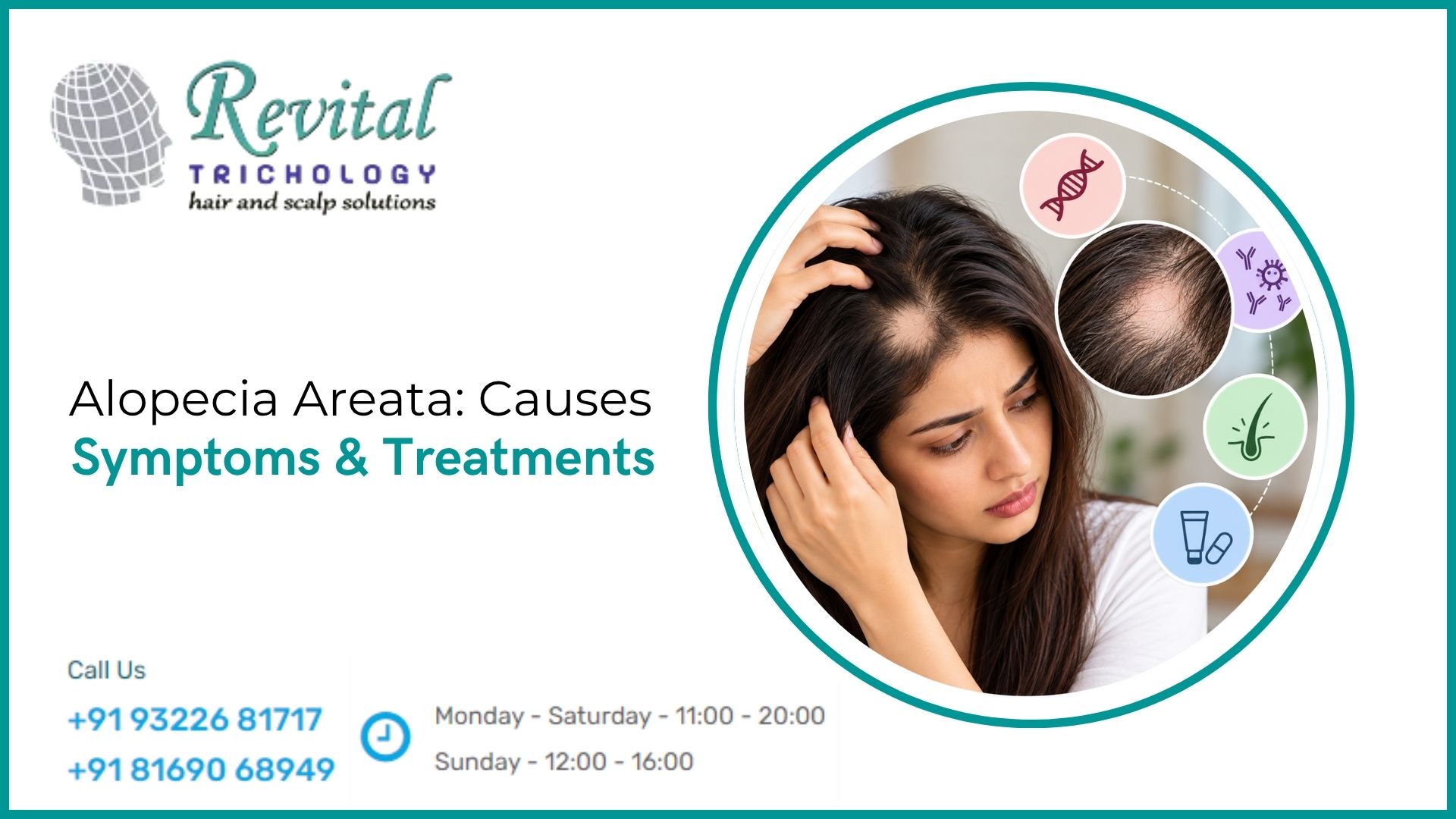
Imagine getting ready in the morning, running your fingers through your hair, and suddenly noticing a small, round bald patch on your scalp. You don’t remember losing that much hair, and the skin looks completely normal.
At first, you might think it’s due to stress, a vitamin deficiency, or a hair product you’ve recently started using.
But sudden, patchy hair loss can sometimes be a sign of alopecia areata.
Unlike everyday hair shedding, alopecia areata occurs when the immune system mistakenly targets hair follicles. It can affect people of different ages, including children, teenagers, and adults.
The condition can be unpredictable. Some people experience only one or two small patches that eventually regrow, while others develop more extensive hair loss.
Understanding alopecia areata causes and treatments can help you recognise the condition early, know what to expect, and explore appropriate medical care.
What Is Alopecia Areata?
Alopecia areata is a condition that causes hair to fall out in small, usually round or oval patches.
It commonly affects the scalp but can also involve the beard, eyebrows, eyelashes, and other areas where hair grows.
The condition belongs to a group of disorders known as autoimmune diseases. In these conditions, the immune system mistakenly attacks healthy parts of the body.
With alopecia areata, that immune response is directed towards the hair follicles.
The important thing to understand is that this immune attack usually does not permanently destroy the follicles. This means hair regrowth is possible, even after noticeable hair loss.
However, regrowth is not guaranteed, and the condition can return after improvement.
According to the National Institutes of Health (NIH), some people experience spontaneous hair regrowth without treatment, particularly when only a few patches are affected.
What Causes Alopecia Areata?
The exact reason why alopecia areata develops is not fully understood.
Researchers believe it results from a combination of genetic susceptibility, immune system changes, and possible environmental influences.
Let’s look at the factors that may contribute.
1. The Immune System Attacks Hair Follicles
Under normal circumstances, the immune system protects the body against infections and harmful substances.
In alopecia areata, immune cells mistakenly attack the structures involved in hair growth.
This disrupts the normal activity of the hair follicle, causing hair to shed or stop growing in the affected area.
The follicles often remain capable of producing hair again if the immune attack settles or responds to treatment.
This is why alopecia areata differs from certain scarring forms of hair loss, where permanent follicle destruction can occur.
2. Genetics and Family History
Alopecia areata sometimes runs in families.
If a close relative has the condition, your chances of developing it may be higher.
However, having a family history doesn’t mean you will definitely experience hair loss.
Many people diagnosed with alopecia areata have no known family history.
Genetics influence susceptibility, but they do not fully explain why the condition begins at a particular time.
3. Stress May Be a Trigger in Some People
Have you ever noticed sudden hair changes after a particularly difficult period?
Some people report significant stress before developing alopecia areata.
Researchers are studying how stress-related biological responses may interact with the immune system.
However, stress has not been established as the direct cause of every case.
Alopecia areata can develop in people who are not experiencing unusual stress.
It is also important not to confuse this condition with stress-related telogen effluvium, which usually causes more widespread shedding rather than distinct round bald patches.
4. Other Autoimmune Conditions
People with alopecia areata have an increased likelihood of certain other immune-related conditions.
These include autoimmune thyroid disease and vitiligo, a condition that causes patches of skin to lose pigmentation.
Conditions such as atopic dermatitis may also be more common among people with alopecia areata.
However, this doesn’t mean everyone with alopecia areata has another autoimmune disorder.
A healthcare professional may recommend further investigation when symptoms or medical history suggest an associated condition.
What Are the Early Symptoms of Alopecia Areata?
Alopecia areata often develops without pain or obvious warning signs.
The most recognisable symptom is a smooth, round patch of missing hair.
You may notice:
- One or more circular bald patches on the scalp
- Sudden hair loss in the beard or eyebrows
- Smooth-looking skin in the affected areas
- Small, short hairs around the edges of patches
- New bald patches appearing over time
- Changes in fingernails, such as tiny dents or ridges
Some people experience mild itching, tingling, or discomfort before hair falls out, but many have no scalp symptoms.
A dermatologist may also notice short hairs that are narrower near the scalp, sometimes called exclamation mark hairs.
These findings can help distinguish alopecia areata from other causes of hair loss.
The American Academy of Dermatology explains that alopecia areata can affect both hair follicles and nails.
If you notice sudden patchy hair loss, seek professional assessment rather than assuming it will resolve on its own.
Are There Different Types of Alopecia Areata?
Yes. The condition can affect different amounts of hair.
Understanding these patterns helps explain why treatment requirements vary.
Patchy Alopecia Areata
This is a common presentation.
One or more small, round patches of hair loss appear on the scalp or other hair-bearing areas.
Some people experience spontaneous regrowth, while others develop new patches.
Alopecia Totalis
Alopecia totalis involves complete or nearly complete loss of scalp hair.
It represents a more extensive form of alopecia areata and can be more difficult to treat.
Alopecia Universalis
Alopecia universalis affects hair across the body.
A person may lose scalp hair, eyebrows, eyelashes, and other body hair.
This is a severe form of the condition, and treatment response can vary considerably.
The extent of hair loss is an important factor when deciding which treatments may be appropriate.
How Is Alopecia Areata Diagnosed?
Alopecia areata is often diagnosed through a clinical examination.
A dermatologist usually begins by examining the pattern of hair loss and asking questions about how quickly the patches developed.
They may also ask about:
- Family history of autoimmune conditions
- Previous episodes of patchy hair loss
- Recent illnesses or medications
- Thyroid-related symptoms
- Changes in the fingernails
- Other scalp symptoms
A handheld magnifying instrument called a dermatoscope may be used to examine the scalp and hair shafts more closely.
In uncertain cases, additional investigations or a scalp biopsy may be considered.
Are Blood Tests Needed?
Not everyone with alopecia areata needs extensive blood testing.
A dermatologist may recommend certain investigations if there are signs of thyroid disease, nutritional deficiencies, or other medical concerns.
These might include thyroid function tests, a complete blood count, or selected nutrient tests.
If you are considering a blood test for hair loss in Mumbai, remember that blood tests alone cannot confirm alopecia areata.
The diagnosis primarily depends on the pattern of hair loss and clinical findings.
Can Alopecia Areata Be Cured Permanently?
There is currently no guaranteed permanent cure for alopecia areata.
However, that doesn’t mean hair cannot grow back.
Many people with limited patchy disease experience some degree of spontaneous regrowth.
Others benefit from medical treatment.
The difficulty is that the condition can return, even after hair has fully regrown.
A person might experience one episode during childhood and never have another, while someone else may experience repeated episodes over several years.
The course is difficult to predict for an individual patient.
The Cleveland Clinic guide to alopecia areata explains how the condition can vary in severity and why treatment responses differ.
What Are the Available Treatments for Alopecia Areata?
The most suitable treatment depends on several factors, including age, the number of patches, how long hair loss has been present, and whether the condition is progressing.
Not every patient needs immediate treatment.
For a small, recent patch, a dermatologist may sometimes recommend monitoring the area before beginning medication.
For more extensive or persistent hair loss, medical treatment may be appropriate.
1. Corticosteroid Injections
Corticosteroid injections are commonly used for selected cases of limited, patchy alopecia areata.
A dermatologist injects small amounts of medication into the affected scalp areas.
The aim is to reduce local immune activity around the follicles.
Some patients experience regrowth over the following months, although results vary and repeat appointments may be required.
Potential side effects include discomfort and temporary thinning of the skin at injection sites.
2. Topical Corticosteroids
Prescription corticosteroid lotions, creams, or solutions may be used to manage inflammation in affected areas.
They are sometimes considered for children or patients who are not suitable for injections.
Response varies, and treatment should be supervised because inappropriate prolonged use can cause side effects.
3. Minoxidil
Minoxidil is a medication used to encourage hair growth in certain conditions.
For alopecia areata, it may sometimes be used alongside other treatments or to help maintain regrowth.
However, minoxidil does not directly address the autoimmune process that causes alopecia areata.
It should not be considered a complete treatment on its own for extensive disease.
4. JAK Inhibitors for Severe Alopecia Areata
One of the more significant developments in alopecia areata treatment has been the introduction of Janus kinase (JAK) inhibitors.
These medicines target signalling pathways involved in the immune response.
The US Food and Drug Administration has approved certain JAK inhibitors for severe alopecia areata, including baricitinib, ritlecitinib, and deuruxolitinib, with different age eligibility requirements.
However, US approval does not automatically mean these medicines are approved or available for the same use in India.
JAK inhibitors also carry important risks, including potentially serious infections and other adverse effects. They require specialist assessment, appropriate testing, and ongoing monitoring.
The American Academy of Dermatology’s treatment guide explains how treatment selection depends on the severity and extent of hair loss.
5. Contact Immunotherapy
Contact immunotherapy may be considered for certain patients with extensive alopecia areata.
It involves applying a carefully selected chemical to the scalp under specialist supervision to produce a controlled immune response.
The treatment requires repeated appointments and is not suitable for everyone.
Possible side effects include significant irritation, eczema-like reactions, and pigmentation changes.
6. What About PRP, GFC and Other Hair Treatments?
PRP, growth factor therapies, mesotherapy, and other hair restoration procedures are sometimes promoted for different types of hair loss.
However, alopecia areata is an autoimmune disease, which makes it different from common genetic hair thinning.
Evidence for procedures such as PRP in alopecia areata remains limited compared with established medical treatments. GFC, mesotherapy, and exosome treatments should not be presented as proven substitutes for immune-directed care.
Someone seeking alopecia areata treatment in Mumbai should therefore understand the diagnosis and the evidence supporting each proposed option before starting treatment.
Can Hair Grow Back Naturally After Alopecia Areata?
Yes, spontaneous hair regrowth is possible, particularly when alopecia areata affects only a few small areas.
Sometimes the first returning hairs are fine, soft, or lighter in colour than the surrounding hair.
Over time, they may become thicker and regain their usual pigmentation.
However, not everyone experiences the same recovery.
Factors such as extensive hair loss, nail involvement, and a long or recurring disease history can affect prognosis.
Even after complete regrowth, another episode can occur.
This unpredictability is one reason regular follow-up may be useful.
Do Diet, Hair Oils or Home Remedies Help Alopecia Areata?
A balanced diet supports overall health, but there is no specific food proven to cure alopecia areata.
Because the condition involves an autoimmune response, simply increasing protein or taking vitamins will not reliably stop the immune system from attacking hair follicles.
Supplements may be helpful when a genuine nutritional deficiency has been identified.
Hair oils can sometimes improve dryness or reduce friction, but they do not treat the underlying autoimmune disease.
Be cautious of products promising complete regrowth within a few weeks.
You can also explore our article on the truth about hair supplements to understand why supplements aren’t always necessary.
How to Care for Your Scalp During Alopecia Areata
Although everyday hair care cannot cure alopecia areata, a few habits may help protect the scalp and remaining hair.
Be gentle while washing. Use a mild shampoo when appropriate and avoid scratching or rubbing affected areas aggressively.
Protect exposed scalp skin. Bald patches can be more vulnerable to sunlight. Use suitable sun protection or a comfortable hat when outdoors.
Avoid tight hairstyles. Repeated pulling can cause additional hair damage.
Take care with cosmetic products. Avoid harsh chemical treatments if your scalp is irritated or sensitive.
Don’t ignore emotional well-being. Patchy hair loss can affect self-confidence, social interactions, and daily comfort. Support from family, friends, or a mental health professional may help when needed.
If you have ongoing irritation or other scalp concerns, explore the available hair and scalp care services.
When Should You Consult a Hair Specialist?
A new bald patch deserves assessment, particularly if it appears suddenly or begins expanding.
Early evaluation can also help rule out fungal infections, hair pulling, and other conditions that may resemble alopecia areata.
Consider seeking advice if you notice:
- One or more smooth bald patches
- Rapidly expanding areas of hair loss
- Eyebrow or eyelash shedding
- Repeated episodes of patchy hair loss
- Fingernail changes alongside hair loss
- Pain, redness, scaling, or inflammation on the scalp
When searching for the best trichologist in Mumbai, consider the professional’s qualifications and whether an appropriately trained dermatologist is involved in diagnosing and managing autoimmune hair loss.
At Revital Trichology & Wellness, individuals experiencing sudden or recurring patchy hair loss can explore available assessment and care options.
A clear diagnosis helps determine whether monitoring, medication, specialist treatment, or further investigation is appropriate.
Conclusion
Alopecia areata can begin unexpectedly, sometimes with only a single small bald patch.
Because the condition is linked to the immune system, it differs from ordinary hair shedding caused by stress, nutrition, or genetic pattern hair loss.
The exact cause is not completely understood, but genetics and immune system activity play important roles.
While there is no guaranteed permanent cure, spontaneous regrowth is possible, and medical treatments can help some people regain hair.
If you notice sudden patchy hair loss, avoiding unnecessary supplements and getting the condition properly assessed is a sensible first step.
For information about available hair and scalp assessment services, visit Revital Trichology & Wellness.
Frequently Asked Questions
1. What is the main cause of alopecia areata?
Alopecia areata occurs when the immune system mistakenly attacks hair follicles. The exact reason this happens is not fully understood, but genetic susceptibility and immune system changes are involved.
2. Is alopecia areata contagious?
No. Alopecia areata is an autoimmune condition, not an infection. It cannot spread through touching, sharing combs, or living with someone who has the condition.
3. Can alopecia areata go away without treatment?
Yes. Some people, particularly those with limited patchy hair loss, experience spontaneous regrowth. However, the condition may return, and extensive cases are less likely to recover without treatment.
4. How long does alopecia areata take to recover?
Recovery varies considerably. Some people notice regrowth within a few months, while others take longer or experience repeated episodes. There is no fixed recovery timeline.
5. Can stress cause alopecia areata?
Stress may be associated with the onset or worsening of alopecia areata in some individuals, but it has not been established as the direct cause of every case.
6. Is alopecia areata caused by vitamin deficiency?
No. Alopecia areata is primarily an autoimmune condition. Nutritional deficiencies can cause other forms of hair shedding and may coexist with alopecia areata, but they are not its established underlying cause.
7. What is the best treatment for alopecia areata?
There is no single best treatment for everyone. Corticosteroid injections or topical treatments may be used for limited disease, while selected patients with severe alopecia areata may be considered for specialist immune-directed treatments, including JAK inhibitors where approved and appropriate.
8. Can alopecia areata affect children?
Yes. Alopecia areata can develop in children as well as adults. Treatment decisions depend on the child’s age, disease severity, and individual medical circumstances. A dermatologist experienced in paediatric hair disorders should guide care.