


What if the future of skin rejuvenation isn’t only about what we put on the skin?
What if we could also explore the cellular signals involved in repair, regeneration and healthy aging?
That is one of the reasons peptides have become such an exciting area of regenerative and longevity medicine.
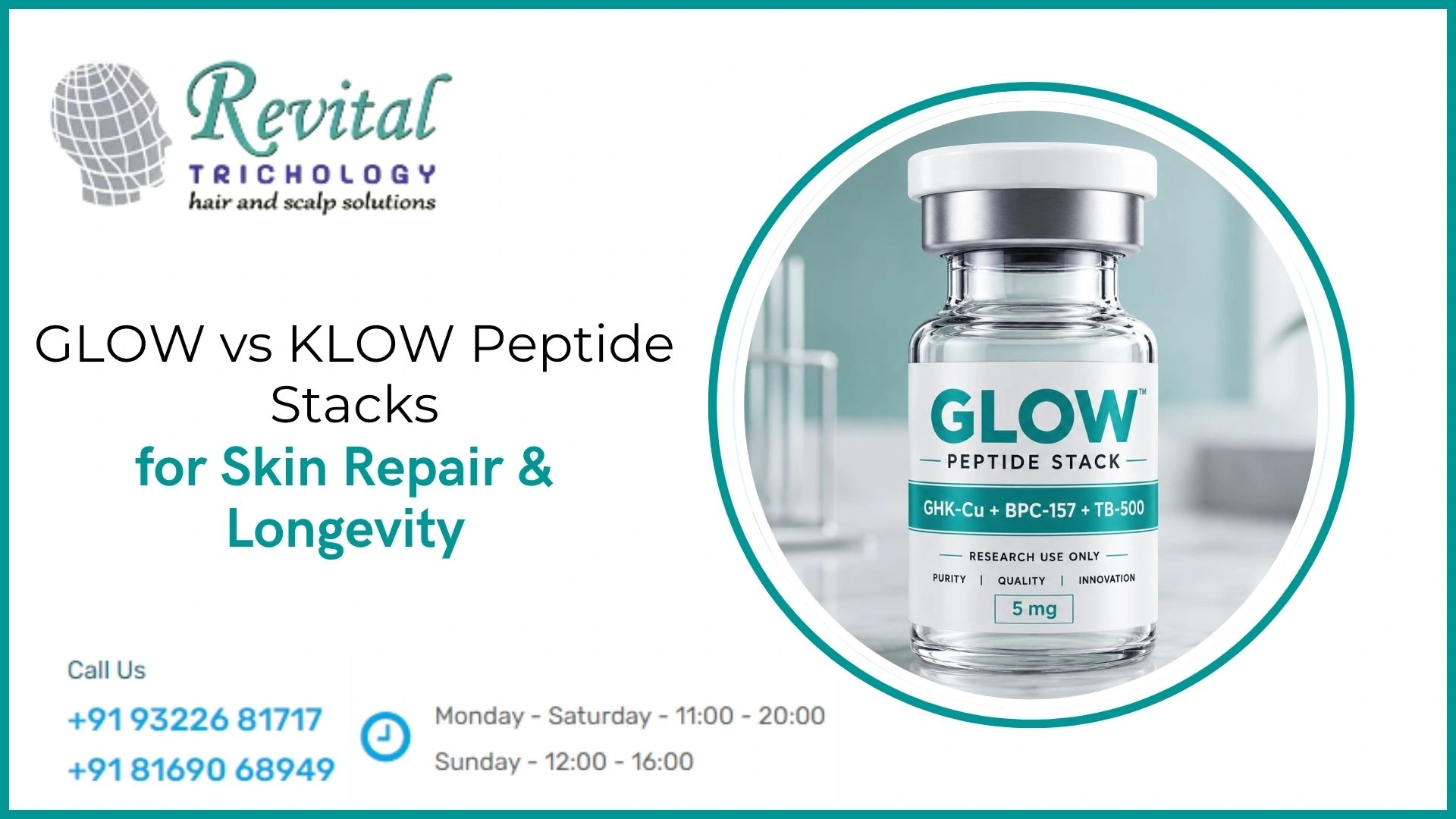
Among the peptide combinations generating curiosity today are the GLOW peptide stack and the KLOW peptide stack.
They are commonly discussed in relation to skin quality, collagen, tissue repair, recovery and inflammatory signalling.
But there is an important point to remember.
Peptides are not something to experiment with on your own.
Any peptide protocol should be considered only after an individual medical assessment and carried out under the guidance of a qualified medical professional.
So what exactly are GLOW and KLOW?
Let’s explore.
What Is the GLOW Peptide Stack?
GLOW is generally associated with three peptides:
GHK-Cu + BPC-157 + TB-500
The concept behind this combination is particularly interesting because the three peptides are associated with different areas of cellular and tissue biology.
Rather than simply focusing on the visible appearance of the skin, the GLOW concept looks at processes involved in tissue repair, extracellular matrix biology and cellular signalling.
This is what makes peptides different from conventional skincare.
They are being explored not simply as cosmetic ingredients, but as molecules capable of interacting with biological signalling pathways.
GHK-Cu: The Peptide Behind the “Glow”
When people talk about peptides for skin, GHK-Cu is often one of the first names that comes up.
GHK-Cu is a copper binding peptide that has been studied extensively in relation to skin and tissue biology.
Its areas of interest include:
- Collagen and extracellular matrix support
- Skin remodeling
- Tissue repair
- Cellular signalling
- Skin elasticity
- Wound healing
This is why GHK-Cu has become particularly interesting in regenerative aesthetics.
The idea isn’t simply to make the skin look temporarily better.
It is to explore the biological processes involved in maintaining healthy skin structure.
And that is where the concept of skin longevity becomes particularly interesting.
BPC-157: The Repair Connection
BPC-157 has become one of the most talked about experimental peptides in regenerative medicine.
Research has explored its potential relationship with processes involved in:
- Tissue repair
- Recovery
- Wound healing
- Vascular biology
- Gastrointestinal biology
This has created considerable interest among people looking beyond conventional approaches to recovery and tissue health.
Within the GLOW concept, BPC-157 brings a repair and recovery perspective alongside the extracellular matrix focus of GHK-Cu.
However, because BPC-157 remains an experimental peptide, it should only be considered within an appropriate medical framework.
TB-500: The Regenerative Connection
TB-500 is commonly discussed in connection with thymosin beta 4 related research.
It has attracted interest around biological processes involving:
- Cell migration
- Tissue repair
- Recovery
- Angiogenesis
- Regenerative processes
This provides another dimension to the GLOW concept.
Instead of looking at skin as simply something that needs to be tightened, brightened or resurfaced, the peptide approach asks a different question:
Can we support the biological environment involved in tissue repair and remodeling?
That is a fascinating area of emerging research.
What Is the KLOW Peptide Stack?
Now comes the interesting difference.
KLOW generally builds on the GLOW combination by adding KPV.
So the combination commonly described as KLOW is:
GHK-Cu + BPC-157 + TB-500 + KPV
And that additional peptide introduces another area of biological interest.
KPV: The Inflammation Connection
KPV is a small peptide fragment derived from alpha melanocyte stimulating hormone.
It has attracted research interest because of its potential relationship with inflammatory signalling.
Why does that matter when we are talking about skin and longevity?
Because inflammation is increasingly recognized as an important component of the aging process.
Our skin is continuously exposed to environmental and biological stressors including:
- UV radiation
- Oxidative stress
- Environmental pollution
- Poor sleep
- Metabolic stress
- Chronic inflammatory signals
Over time, these factors can influence the skin’s ability to maintain and repair itself.
This has led to growing interest in the concept of inflammaging, the chronic low grade inflammatory environment associated with aging.
And this is where KPV adds an intriguing dimension to the GLOW concept.
GLOW vs KLOW: What Is the Difference?
Think of it this way.
GLOW focuses on three major areas:
GHK-Cu for extracellular matrix and skin biology
BPC-157 for tissue repair and recovery research
TB-500 for regenerative and tissue repair research
KLOW adds:
KPV for an additional focus on inflammatory signalling.
So KLOW isn’t necessarily about simply making GLOW “stronger.”
It introduces another biological pathway into the discussion.
And that is an important principle in peptide medicine:
More peptides do not automatically mean better results.
The right approach is to first understand the individual’s goals, biology and medical history.
Why Are GLOW and KLOW So Interesting for Skin Longevity?
Aging skin is not simply about wrinkles.
As we age, multiple processes change simultaneously.
These include:
- Collagen production
- Extracellular matrix structure
- Cellular communication
- Tissue repair
- Oxidative balance
- Inflammatory signalling
- Skin barrier function
This is why the conversation around longevity is moving beyond simply treating visible signs of aging.
The bigger question is:
Can we support healthier biological function as we age?
Peptides are attracting attention because they provide a way of exploring this question at the level of cellular signalling.
Could GLOW and KLOW Be About More Than Skin?
Although these combinations are often discussed in the context of skin and aesthetics, their individual components have attracted research interest across several areas of tissue biology.
That includes:
Skin quality
Tissue repair
Recovery
Extracellular matrix biology
Inflammatory signalling
Healthy aging
This broader perspective is one reason Peptide Therapy has become such an interesting area of modern longevity medicine.
The conversation is shifting from simply replacing what the body has lost to understanding the signals that influence how cells behave.
Is GLOW Better Than KLOW?
There is no simple answer.
And this is where individualized medical guidance becomes important.
The appropriate approach depends on what you are trying to achieve.
Someone primarily interested in skin quality may have a very different strategy from someone seeking support around tissue recovery or inflammatory pathways.
A responsible peptide protocol should therefore begin with:
What is the goal?
Which biological pathway are we trying to influence?
Is the peptide appropriate for this individual?
What are the potential risks?
What evidence supports its use?
This is very different from choosing a peptide stack simply because it is trending on social media.
Peptide Therapy Should Be Personalized
One of the biggest misconceptions about peptides is that there is a universal “best stack.”
There isn’t.
A Peptide Protocol should be based on the individual rather than a popular combination circulating online.
Medical assessment can help determine whether peptide therapy is appropriate and whether other factors such as medications, underlying conditions, laboratory findings, age and treatment goals need to be considered.
GLOW and KLOW should therefore be viewed as emerging peptide concepts, not DIY wellness protocols.
If considered, they should be used only under appropriate medical supervision.
The Future of Peptide Therapy
The excitement around peptides isn’t really about finding one miracle molecule.
It is about understanding cellular communication.
GHK-Cu.
BPC-157.
TB-500.
KPV.
Each provides a different window into biological signalling.
Together, they illustrate why peptides have become such a fascinating area of regenerative and longevity medicine.
The future may not be about asking:
“Which peptide is the best?”
It may be about asking:
“Which biological signals are relevant to this individual?”
That is a much more sophisticated way to think about peptide therapy.
What Does the Research Actually Say?
The science behind the individual peptides is interesting, but it is important to separate promising biology from established clinical medicine.
The individual peptides in GLOW and KLOW have been studied to varying degrees, with much of the available evidence coming from laboratory and preclinical research. Robust clinical evidence for the complete GLOW or KLOW combinations in humans remains limited.
Long term safety, optimal protocols and clinical effectiveness require further research.
Therefore, these combinations should not be presented as proven anti-aging or regenerative treatments.
They are part of an evolving area of peptide research that requires careful medical evaluation, appropriate product quality and responsible clinical oversight.
The promise of peptide therapy is not that peptides are magic.
It is that we are beginning to understand more about the tiny biological signals that influence how our cells communicate, repair and function.
And that may be where the next chapter of regenerative and longevity medicine begins.