


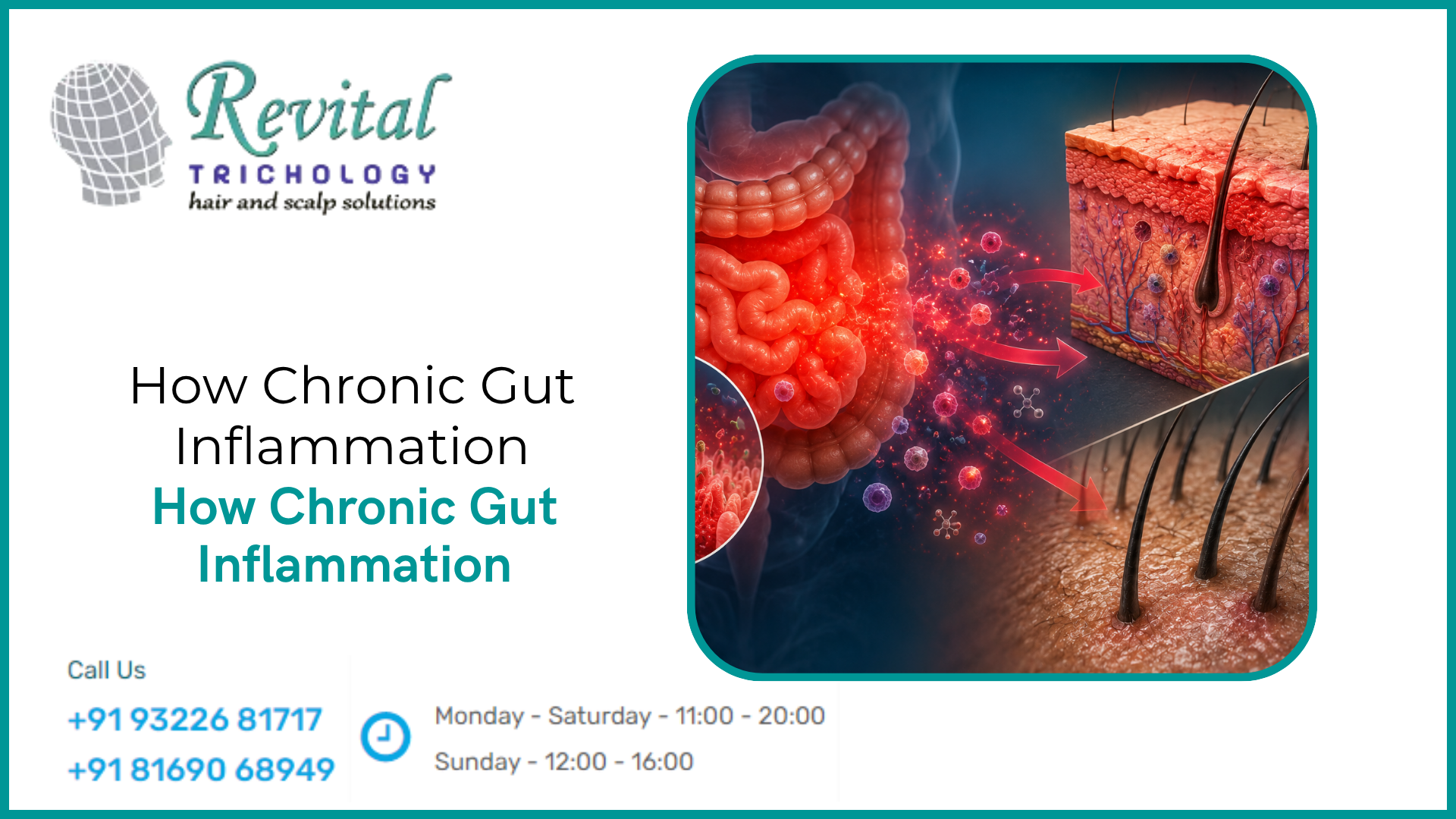
Most people think of gut problems as digestive problems.
Bloating, acidity, constipation, diarrhoea, abdominal discomfort. Those are usually the symptoms that get attention.
What often goes unnoticed is that chronic gut inflammation can show up far away from the digestive system. In many cases, the skin and hair reveal problems long before someone receives a formal diagnosis. Persistent acne, unexplained hair shedding, scalp irritation, rosacea-like symptoms, eczema flare-ups, and poor skin healing can sometimes have deeper roots than skincare products or hair treatments alone can address.
As interest grows in functional medicine and regenerative therapies, researchers are exploring approaches such as BPC-157 to reduce gut mucosal inflammation as part of broader strategies aimed at restoring gut health. To understand why this area is receiving attention, it helps to first understand the connection between the gut, the skin, and the hair follicle.
The gut does much more than digest food
The digestive tract is often described as the body’s largest immune organ.
That isn’t an exaggeration.
A significant portion of the immune system interacts directly with the gut lining every day. The digestive tract constantly processes food, bacteria, toxins, environmental compounds, and countless other substances.
To manage all of this, the gut relies on a protective barrier known as the intestinal lining.
When functioning properly, this barrier acts like a highly selective filter. Nutrients pass through. Harmful substances stay out.
Problems begin when chronic inflammation disrupts that process.
The consequences are not always limited to the digestive system.
Why gut inflammation can affect your skin
Dermatologists and functional medicine practitioners increasingly recognise what is often called the gut-skin axis.
The concept is relatively straightforward.
When inflammation becomes persistent within the digestive tract, inflammatory signals can circulate throughout the body.
The skin frequently responds.
Some people develop:
- Persistent acne
- Rosacea
- Eczema flare-ups
- Increased skin sensitivity
- Delayed wound healing
- Chronic redness
- Unexplained irritation
Not every skin condition originates in the gut.
Far from it.
However, when conventional treatments provide only temporary relief, it becomes reasonable to investigate whether underlying inflammatory processes are contributing to the problem.
This is especially true when skin symptoms occur alongside digestive complaints.
Hair follicles are surprisingly sensitive to inflammation
People often think of hair loss as a hormonal issue.
Sometimes it is.
But hair follicles are also highly responsive to inflammation, nutritional status, immune activity, and metabolic health.
This is where chronic gut dysfunction can become relevant.
Inflamed digestive tissue may affect:
- Nutrient absorption
- Immune regulation
- Hormonal balance
- Cellular repair processes
Hair follicles depend on all four.
When those systems become disrupted, the hair growth cycle can become unstable.
The result may appear as:
- Excessive hair shedding
- Diffuse thinning
- Reduced hair density
- Slower regrowth
- Increased scalp sensitivity
In clinical practice, it is not uncommon to see patients focus entirely on their hair while overlooking ongoing digestive symptoms that may have been present for years.
Nutrient deficiencies are often part of the story
One of the most overlooked consequences of chronic gut inflammation is impaired nutrient absorption.
Hair growth requires a steady supply of nutrients.
These include:
- Iron
- Zinc
- Protein
- Vitamin D
- B vitamins
- Essential fatty acids
Skin health relies on many of the same nutrients.
A person may eat a nutrient-rich diet and still develop deficiencies if chronic inflammation interferes with absorption.
This distinction matters.
Simply increasing nutrient intake does not always solve the problem if the digestive tract is struggling to utilise those nutrients effectively.
Why chronic inflammation can trigger hair shedding
The hair growth cycle follows a predictable rhythm.
Individual follicles move through phases of:
- Growth
- Transition
- Resting
- Shedding
Various stressors can interrupt this cycle.
Inflammation is one of them.
When inflammatory activity becomes chronic, more follicles may enter the shedding phase prematurely.
This process is often seen in a condition called telogen effluvium.
Patients frequently describe it as:
“I suddenly started losing hair everywhere.”
The trigger may be:
- Illness
- Surgery
- Emotional stress
- Nutritional deficiency
- Chronic inflammatory conditions
The challenge is that shedding often begins months after the initial trigger, making it difficult to identify the original cause.
The gut-skin-hair connection is not always obvious
One reason these cases can be difficult is that symptoms rarely arrive together.
A patient may develop digestive complaints first.
Years later, skin issues emerge.
Hair shedding may appear even later.
By the time they seek help for their hair, the underlying gut problem may have become normalised.
Many people accept symptoms such as:
- Bloating after meals
- Irregular digestion
- Food sensitivities
- Chronic acidity
as part of everyday life.
They do not necessarily connect these issues with their scalp or skin.
Yet from a biological perspective, these systems remain interconnected.
What is BPC-157?
Interest in BPC-157 to reduce gut mucosal inflammation has grown largely because of its potential role in tissue repair and recovery.
BPC-157 is a peptide derived from a protective protein sequence found in gastric juice.
Researchers have explored its potential effects in areas involving:
- Tissue healing
- Gastrointestinal health
- Inflammation
- Blood vessel formation
- Cellular repair
While scientific interest continues to evolve, much of the attention surrounding BPC-157 comes from its potential relationship with gut tissue recovery.
This has made it a topic of discussion within regenerative medicine and functional medicine communities.
Why gut lining health matters
The intestinal lining is only one cell thick in many areas.
Despite its thin structure, it performs an extraordinary amount of work.
It helps regulate:
- Nutrient absorption
- Immune responses
- Barrier function
- Communication between the gut and the rest of the body
When inflammation becomes persistent, this barrier may become less efficient.
The result can contribute to ongoing immune activation and systemic inflammation.
Because both the skin and hair follicles respond to inflammatory signals, improvements in gut health often become relevant when addressing broader wellness concerns.
Looking beyond symptoms
One common mistake is treating each symptom independently.
The skin gets a cream.
The scalp gets a serum.
The digestive system gets an antacid.
Sometimes those interventions help.
Sometimes they don’t.
When symptoms continue returning despite treatment, a broader evaluation may be necessary.
Questions worth exploring include:
- Is chronic inflammation present?
- Are nutrient deficiencies involved?
- Is digestion functioning properly?
- Are hormonal factors contributing?
- Are immune pathways playing a role?
The answers are rarely identical from one patient to another.
Why a root-cause approach matters
The relationship between gut health, skin health, and hair growth is complex.
There is rarely a single explanation.
For one person, nutritional deficiencies may be driving the problem.
For another, chronic inflammatory conditions may play a larger role.
For someone else, hormonal imbalances and digestive dysfunction may be occurring simultaneously.
This is why lasting improvement often requires looking beyond the visible symptom.
The hair loss may be real.
The acne may be real.
The scalp irritation may be real.
But they may not be the starting point.
Healthy hair and skin often begin internally
People naturally focus on what they can see.
A thinning hairline.
An irritated scalp.
Recurring skin flare-ups.
Yet the body rarely operates in isolated compartments.
The digestive system, immune system, endocrine system, skin, and hair follicles constantly influence one another.
Understanding these connections does not mean every skin or hair concern originates in the gut.
It simply means the gut deserves consideration when conventional approaches fail to provide lasting answers.
Conclusion
Chronic gut inflammation can affect far more than digestion. Through its influence on nutrient absorption, immune activity, inflammation, and overall metabolic function, it may contribute to changes in both skin health and hair growth. Growing interest in BPC-157 to reduce gut mucosal inflammation reflects a broader shift towards understanding how internal health influences visible symptoms rather than treating each concern in isolation.
At Revital Trichology & Wellness, we often see patients whose hair and scalp concerns extend beyond the follicle itself. Our approach focuses on identifying underlying factors that may be contributing to hair thinning, shedding, or inflammatory skin concerns, including nutritional, hormonal, metabolic, and digestive influences. By understanding the bigger picture, it becomes possible to create more personalised treatment strategies that support long-term health as well as appearance.
Frequently Asked Questions
Can gut inflammation cause hair loss?
Chronic gut inflammation may contribute to hair shedding by affecting nutrient absorption, immune regulation, and inflammatory pathways involved in the hair growth cycle.
How does gut health affect the skin?
The gut and skin communicate through immune and inflammatory pathways. Ongoing gut inflammation may contribute to certain skin conditions in susceptible individuals.
What are common signs of chronic gut inflammation?
Persistent bloating, digestive discomfort, food sensitivities, irregular bowel habits, and ongoing gastrointestinal symptoms may indicate underlying inflammation.
What is BPC-157 to reduce gut mucosal inflammation?
BPC-157 is a peptide being studied for its potential role in tissue repair, gastrointestinal health, and inflammatory processes.
Can nutrient deficiencies from gut problems affect hair growth?
Yes. Deficiencies involving iron, zinc, vitamin D, protein, and other nutrients can influence hair growth and follicle health.
Is every skin condition linked to the gut?
No. Many skin conditions have multiple causes, although gut health may be a contributing factor in some individuals.
When should I investigate gut health for hair loss?
If hair loss occurs alongside digestive symptoms, nutrient deficiencies, chronic inflammation, or unexplained skin issues, a broader evaluation may be worthwhile.