


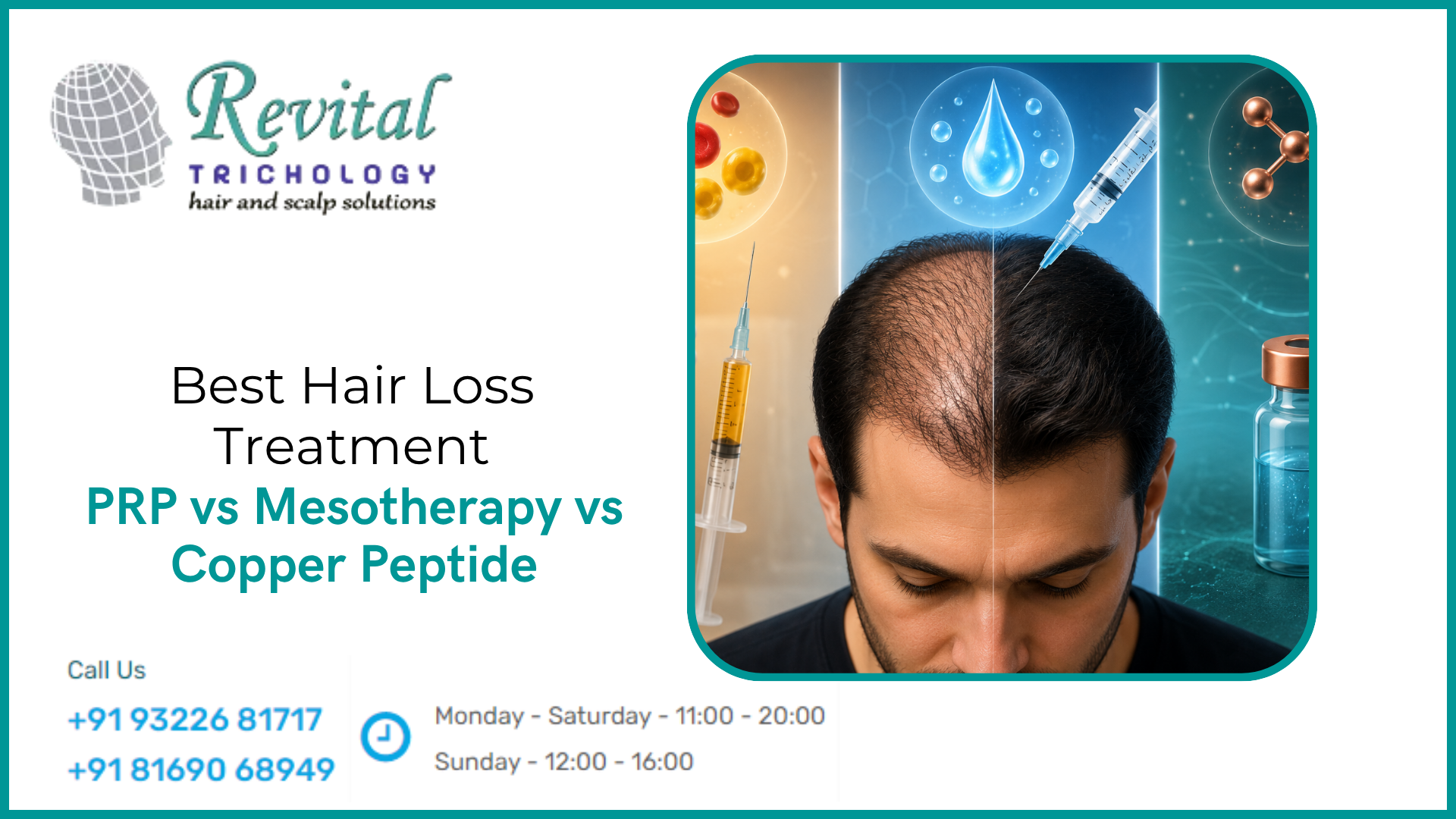
Hair loss treatments have changed considerably over the last decade. What was once a choice between medications and hair transplants has expanded into a growing field of regenerative and scalp-based therapies. Among the options attracting attention today are PRP, mesotherapy, and GHK-Cu copper peptide therapy in Mumbai. All three are used in hair restoration, yet they are often discussed as though they do the same thing.
They don’t.
A patient researching hair loss treatments will quickly encounter all three approaches, sometimes promoted as alternatives and sometimes as complementary therapies. This creates confusion. If they are all designed to improve hair growth, why would a trichologist recommend one over another?
The answer lies in understanding how each treatment works, who is likely to benefit, and where each option fits within a broader hair restoration strategy.
The first question shouldn’t be “Which treatment is best?”
It should be:
“What is causing the hair loss?”
This is where many treatment discussions go off track.
A person experiencing early male pattern hair loss has different needs from someone with postpartum shedding. Likewise, someone with nutritional deficiencies, thyroid dysfunction, PCOS, chronic stress, or inflammatory scalp conditions may require an entirely different approach.
The treatment itself is only one part of the equation.
The quality of diagnosis often determines whether the treatment succeeds.
This is why experienced trichologists rarely start with a procedure. They start with the scalp, the medical history, blood investigations where necessary, and an understanding of how the hair loss developed.
Only then does treatment selection become meaningful.
Understanding PRP: using your body’s own growth factors
PRP, or Platelet-Rich Plasma, remains one of the most widely recognised regenerative treatments for hair loss.
The process involves drawing a small amount of blood, concentrating the platelets, and injecting the platelet-rich portion into the scalp.
Why platelets?
Because they contain growth factors that help support tissue repair and cellular activity.
The goal is not to create brand-new hair follicles.
This is one of the most common misconceptions surrounding PRP.
Hair follicles that have disappeared completely cannot be revived. PRP works best when follicles are still present but becoming weaker, smaller, or less productive.
In practical terms, PRP is often used to:
- Reduce excessive shedding
- Improve follicle function
- Support existing hair growth
- Improve hair density
- Slow progression of thinning
Many patients notice that hair fall reduces before they notice visible thickening. This makes sense biologically. Stabilising the follicle often comes before visible improvement.
Who tends to respond best to PRP?
PRP generally works best in:
- Early-stage androgenetic alopecia
- Mild to moderate thinning
- Younger patients with active follicles
- Individuals seeking non-surgical intervention
Results tend to be less predictable when significant follicle miniaturisation has already occurred.
Mesotherapy is not really a treatment. It’s a delivery system.
This is one area where online information often creates confusion.
Patients frequently compare PRP and mesotherapy as though they are equivalent therapies.
They are not.
PRP refers to what is being injected.
Mesotherapy refers to how substances are delivered into the scalp.
Think of mesotherapy as a vehicle.
The ingredients can vary significantly.
Depending on the clinic and treatment plan, mesotherapy formulations may contain:
- Vitamins
- Amino acids
- Minerals
- Peptides
- Hyaluronic acid
- Growth-supporting compounds
This flexibility is both mesotherapy’s greatest strength and its biggest challenge.
A well-designed protocol can be highly targeted.
A poorly designed protocol may offer little meaningful benefit.
The quality of the formulation matters enormously.
Where mesotherapy may be useful
Mesotherapy is often considered when the goal is to improve the scalp environment.
For example:
A patient may have hair thinning combined with nutritional deficiencies or poor scalp health.
Rather than relying solely on oral supplementation, specific ingredients can be delivered directly into the treatment area.
Many practitioners also combine mesotherapy with other regenerative approaches.
This is why asking whether PRP is “better” than mesotherapy isn’t always the right question.
In some situations, they serve different purposes.
Why copper peptides have generated so much interest
Copper peptides have moved from niche scientific discussions into mainstream hair restoration conversations.
The particular molecule receiving the most attention is GHK-Cu.
Interest in GHK-Cu copper peptide therapy in Mumbai has grown because copper peptides sit at the intersection of regenerative medicine, wound healing research, and hair restoration.
Unlike PRP, which relies on naturally occurring growth factors obtained from blood, GHK-Cu is a naturally occurring peptide complex that interacts with biological signalling pathways.
That distinction matters.
Rather than acting as a growth factor source, copper peptides appear to influence cellular communication.
Researchers have investigated their potential role in:
- Tissue repair
- Inflammation regulation
- Collagen production
- Skin rejuvenation
- Hair follicle health
This has led to growing interest in their application within scalp and hair restoration protocols.
What makes GHK-Cu different from traditional hair loss treatments?
Many hair loss therapies focus on either hormones or blood supply.
Copper peptides introduce another dimension.
They are being explored because of their potential influence on the follicular environment itself.
Hair follicles do not function in isolation.
They exist within a complex ecosystem involving:
- Blood vessels
- Immune signalling
- Inflammatory processes
- Growth factors
- Stem cell activity
Researchers believe copper peptides may help support some of these processes.
That does not mean they are a miracle cure.
It does mean they represent an interesting area of regenerative medicine that continues to evolve.
Comparing the three approaches
One reason comparison articles often become misleading is because they assume every treatment is trying to accomplish the same thing.
In reality, the mechanisms differ substantially.
PRP
PRP focuses on delivering concentrated growth factors obtained from the patient’s own blood.
Its primary role is regenerative stimulation.
Mesotherapy
Mesotherapy focuses on delivering selected ingredients directly into the scalp.
Its value depends heavily on the formulation being used.
Copper Peptides
GHK-Cu copper peptide therapy in Mumbai focuses on biological signalling pathways associated with tissue repair and follicular support.
While there is some overlap between these treatments, they are not interchangeable.
Which treatment is most suitable for early hair loss?
For individuals experiencing early thinning, the answer depends on what is happening beneath the surface.
If the follicles remain healthy but are beginning to weaken, PRP may be a strong option.
If scalp quality, nutrition-related concerns, or targeted ingredient delivery are important factors, mesotherapy may play a useful role.
If regenerative signalling and follicular support are key treatment objectives, copper peptide-based protocols may become part of the discussion.
This is precisely why treatment selection should be individualised.
Hair loss rarely follows a standard template.
Can these treatments be combined?
This is another question that patients frequently ask.
And the answer is often yes.
In clinical practice, combination approaches are increasingly common.
A patient may receive:
- PRP to stimulate follicular activity
- Mesotherapy to deliver supportive ingredients
- Copper peptide-based therapies as part of a regenerative programme
The rationale is straightforward.
Different therapies may address different aspects of follicular health.
This approach is often more sophisticated than relying on a single intervention.
What patients often misunderstand about regenerative hair treatments
One of the biggest challenges in hair restoration is expectation management.
Marketing frequently creates the impression that every patient will experience dramatic regrowth.
The reality is more nuanced.
Some patients are trying to regrow hair.
Others are trying to preserve it.
Those goals are not identical.
A treatment that successfully slows progression may be clinically valuable even if the change is not immediately obvious in photographs.
Likewise, preserving density for the next five years may be just as important as achieving visible thickening over the next six months.
Experienced practitioners understand this distinction.
Patients often discover it later.
The treatment matters. The diagnosis matters more.
When comparing PRP, mesotherapy, and GHK-Cu copper peptide therapy in Mumbai, it is tempting to search for a winner.
Most of the time, there isn’t one.
The better question is:
Which treatment aligns with the biology of the person sitting in front of the clinician?
Someone with androgenetic alopecia may require a different strategy from someone experiencing stress-related shedding.
A patient with inflammatory scalp disease will likely need a different treatment pathway than someone whose follicles are simply becoming less active with age.
This is why the most successful treatment plans are rarely built around trends.
They are built around diagnosis.
Conclusion
PRP, mesotherapy, and copper peptide therapy each occupy a different place within modern hair restoration. PRP relies on the body’s own growth factors, mesotherapy provides a method for delivering targeted ingredients into the scalp, and GHK-Cu copper peptide therapy in Mumbai introduces a regenerative approach focused on biological signalling and follicular support. Rather than asking which treatment is universally best, it is more useful to understand which treatment is most appropriate for the specific type and stage of hair loss being treated.
At Revital Trichology & Wellness, we approach hair restoration by first identifying the underlying cause of thinning before recommending any procedure. Our team evaluates scalp health, follicular activity, medical history, lifestyle factors, and treatment goals to develop personalised plans that may include regenerative therapies such as PRP, mesotherapy, peptide-based treatments, or a combination approach where appropriate.
Frequently Asked Questions
Is PRP better than mesotherapy for hair loss?
Not necessarily. PRP and mesotherapy serve different purposes, and suitability depends on the underlying cause of hair loss.
What is GHK-Cu copper peptide therapy in Mumbai?
It is a regenerative treatment approach that uses copper peptides, particularly GHK-Cu, to support biological processes involved in hair follicle health and tissue repair.
Can PRP regrow completely bald areas?
PRP works best when hair follicles are still present. Completely inactive or absent follicles are unlikely to respond.
Is mesotherapy painful?
Most patients experience mild discomfort during treatment, but the procedure is generally well tolerated.
Can copper peptides be combined with PRP?
Yes. In some treatment plans, copper peptides may be used alongside PRP and other regenerative therapies.
How many sessions are usually required?
The number of sessions varies depending on the treatment chosen, the severity of hair loss, and individual treatment goals.
Which treatment provides the fastest results?
Hair growth is a gradual biological process. Regardless of treatment type, meaningful changes typically require several months of consistent treatment and follow-up.